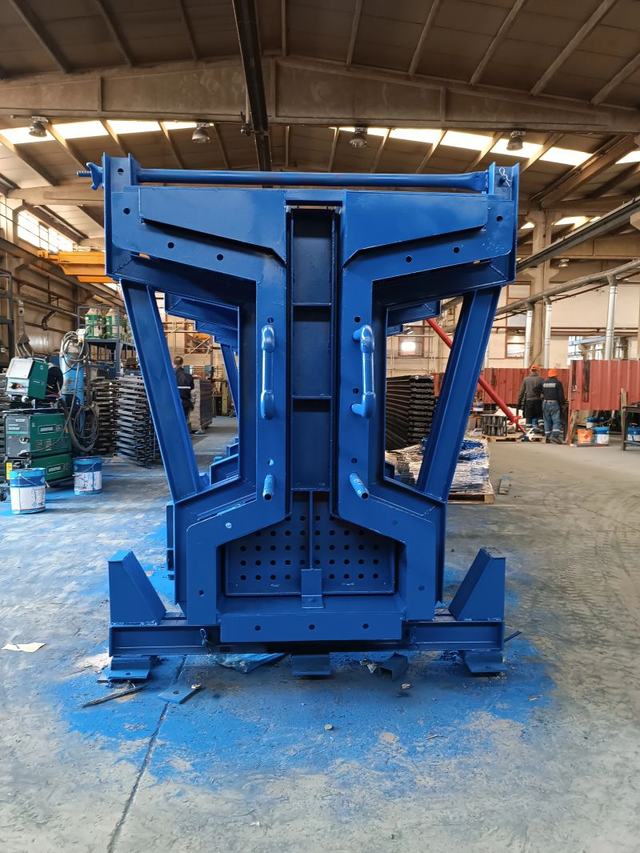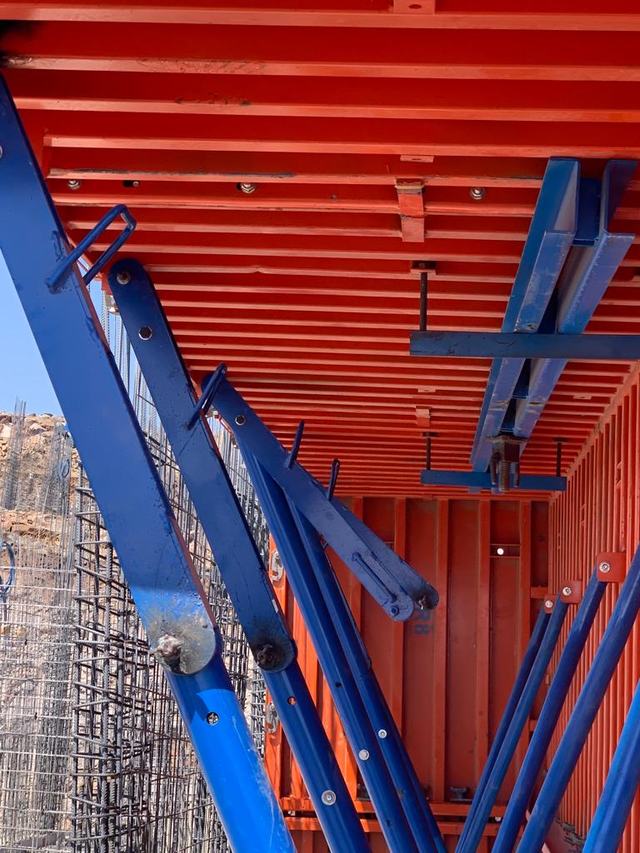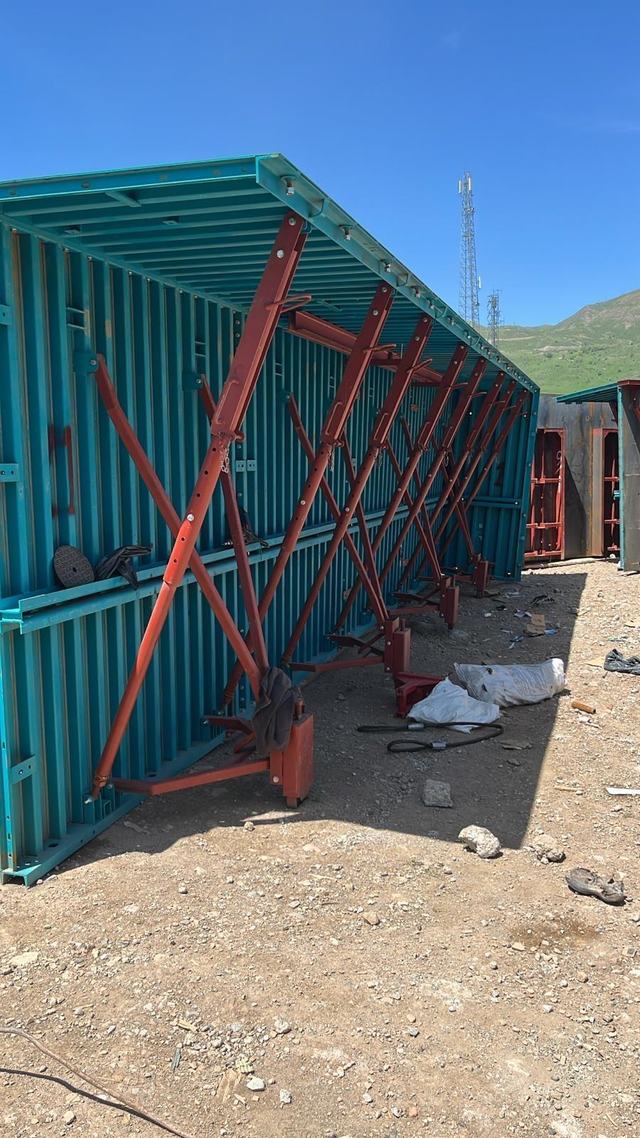

A battery mould is a formwork system that produces precast wall and slab panels vertically, in compartments arranged side by side. A single mould body holds between 6 and 12 compartments, each casting one panel. It yields several times the output of a horizontal tilting table in the same plant area.
The working principle
The mould consists of vertical panels moving on rails. When the panels are brought together, gaps the thickness of the finished panel remain between them; concrete is poured into these gaps from above.
The key point: both faces of the panel touch steel formwork. On a tilting table the upper face is open and finished by trowel; in a battery mould both faces come out at formwork quality. That is a decisive advantage for panels visible on both sides, or held to tight tolerances.
Cycle steps
- Opening — panels are separated by a hydraulic or screw mechanism, making the compartments accessible.
- Cleaning and release agent — contact faces are scraped and a thin film of release agent is applied.
- Edge forms — magnetic or bolted edge profiles defining panel dimensions are placed. Dimensional changes are made by moving these profiles; the mould body stays as it is.
- Reinforcement and cast-in items — mesh reinforcement, lifting anchors, electrical conduits and window void boxes are placed.
- Closing — the panels are clamped; the tie system is locked according to the concrete pressure.
- Pouring — concrete is placed from above, compartment by compartment. Consistency matters: battery moulds generally use flowable concrete or SCC, because vibration is limited in a narrow, deep cavity.
- Curing — steam or hot water is circulated through channels between the panels. Because heat passes directly from the mould plate into the concrete, curing is highly efficient.
- Opening and lifting — once early strength is reached the panels open and the elements are lifted vertically by crane from their anchors. Since the panel is already vertical, no tilting table is needed.
In a well-set-up battery the cycle can come down to 24 hours, and to 12 hours with steam curing.
Comparison with a tilting table
| Battery mould | Tilting table | |
|---|---|---|
| Layout | Vertical, small footprint | Horizontal, large area |
| Output in the same area | 6–12× | 1× |
| Surface | Both faces formwork quality | One face; upper face trowelled |
| Curing efficiency | High — heating between panels | Moderate — heating under the table |
| Lifting | Vertical, direct | Requires tilting |
| Placing cast-in items | Harder in a narrow compartment | Easy, open surface |
| Projecting / complex panels | Not suitable | Suitable |
| Initial investment | High | Lower |
A battery mould is the right tool for flat panels of constant thickness, in high volume. For projecting, stepped or individually varying elements, a tilting table is more practical.
Inputs that govern the design
When ordering a battery mould, the information that defines it is:
- Panel width and height — these give compartment height and width
- Panel thickness range — the adjustable range of the compartment gap
- Number of compartments — derived from the daily output target
- Concrete consistency / SCC — if SCC is used, the tie calculation is made with hydrostatic pressure
- Curing method — steam, hot water or electric; channel design follows
- Crane capacity — the heaviest panel weight plus anchor safety
What to watch on site
- Equal compartment gaps. If one compartment is 2 mm wide, that panel comes out thick; gap settings are checked every cycle.
- Tightness of edge profiles. Leaking concrete builds up in the lower compartments and marks surfaces.
- Pouring rate from above. Fast placement in a narrow cavity traps air and causes blowholes on the face.
- Steam balance. If compartments differ in temperature, panels gain strength at different rates; opening time is set by the coldest compartment.
- Anchor position. Because the panel is lifted vertically, the anchor load is the full panel weight; position and quantity are set by calculation.
Which plants suit it
A battery mould pays off particularly where:
- Enclosed area is limited and output is high
- Repeating wall panels are produced, as in social housing
- Partition wall panels are required smooth on both faces
- Steam infrastructure is in place and the line aims to shorten the cycle
In a plant with ample space, low output and a wide variety of elements, a tilting table remains the more sensible choice.
In short
A battery mould is the most efficient way to produce high volumes of double-faced panels in a small footprint. The gain depends on panel dimensions and the curing method being clear from the start; compartment count and tie calculations follow from that information.
PRODUCT GROUPS IN THIS ARTICLE
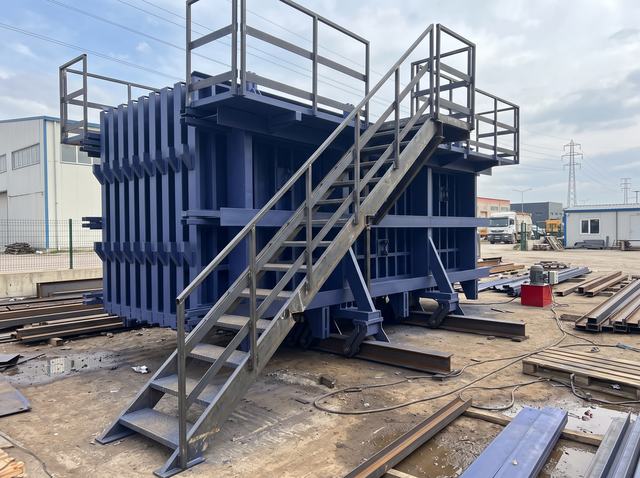
Let us work out the right formwork configuration for your project.
REQUEST A QUOTE