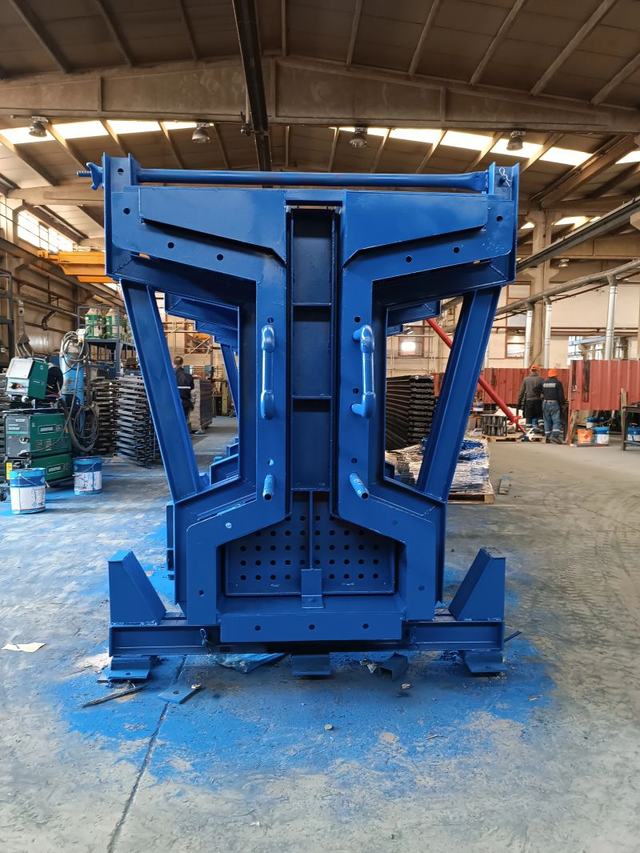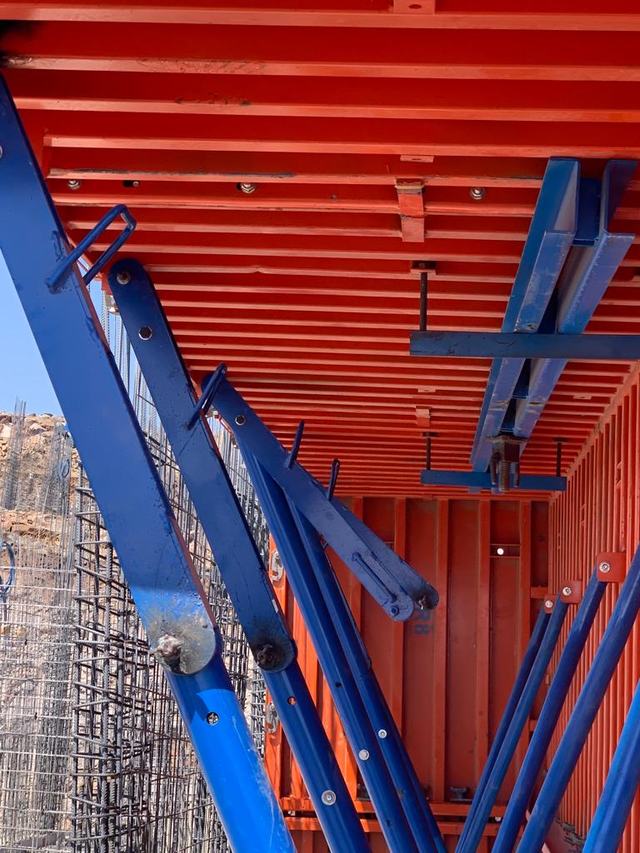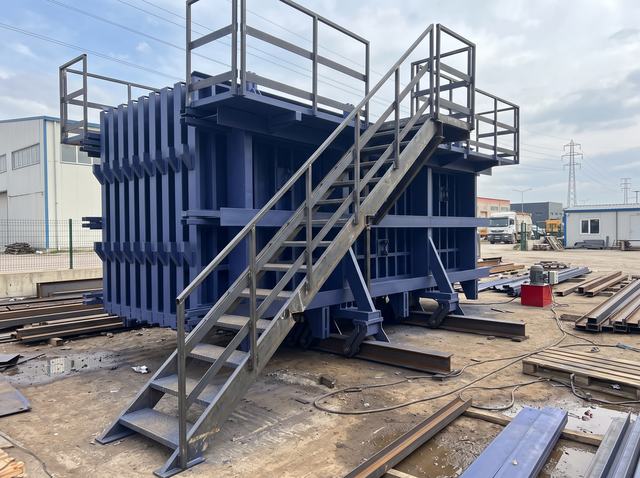

What determines the life of steel formwork is not the grade of the steel but the ten minutes of work done after every pour. The same form will run 2,000 cycles when maintained; without maintenance it starts marking the surface by the 400th pour.
Cleaning after stripping
Concrete is removed from the form before it hardens. Set concrete residue has to be chipped off, and that chipping scars the contact face.
- Scrape the surface with a plastic or wooden spatula as soon as the form is stripped.
- Check corners and the area around tie holes in particular — build-up starts there.
- If using pressure water, do not hold the nozzle perpendicular to the panel; work at 30–45°. A perpendicular jet lifts the coating.
- Use a wire brush only on spot rust, never over a wide surface.
Release agent: little and even
The most common mistake is too much release agent. Excess agent:
- Stains the concrete surface and causes colour variation
- Produces dusting on the surface
- Reduces bond with the reinforcement
Correct application: the agent is sprayed, then wiped with a cloth. What should remain is a matt film, not a wet shine. Typical consumption is 20–40 m² per litre; if you are getting 10 m² per litre, too much is being used.
The type matters too: precast moulds using steam curing need a heat-resistant, emulsion-based product; a cold-pour agent burns under steam and leaves marks on the surface.
Ties, hinges and latches
These are the moving parts of the form and the first to fatigue.
| Part | Check | Frequency |
|---|---|---|
| Tie rod thread | Crushed thread, bending | Every pour |
| Tie nut / plate | Cracks, wear | Weekly |
| Hinge pin | Ovalisation, play | Weekly |
| Latch | Full closure | Every pour |
| Jack spindle | Thread cleanliness, lubrication | Weekly |
| Wheel bearing | Freedom of rotation | Monthly |
A hinge pin with play means a step at the panel joint, which shows up as a line on the concrete surface. Once a pin has 1 mm of play it is replaced, not filled with weld.
Deformation checks
Panel flatness is measured every 100–150 pours:
- Lay a 2 m straight edge against the panel and measure the gap with feeler gauges.
- The typical acceptance limit is 2 mm over 2 m; 1 mm where exposed concrete is required.
- If there is bulging, question the tie spacing and pour rate first — the panel is not at fault, the load is too high.
- Local bulging can be corrected by heating and straightening; widespread bulging means the panel needs reinforcing.
Diagonals are measured too. A diagonal difference directly destroys the squareness of the element; it is the first thing to check if the form has been knocked during craning.
Coating and rust
- Rust on the contact face changes the colour of the concrete; it is a quality issue, not just a cosmetic one.
- Areas where primer has lifted are touched up with the same system; mixing different paints causes the surface to flake.
- If the form will stand idle for a long time, the contact face is sealed with a thin oil film.
Winter and long-term storage
- Wash the form and dry it.
- Apply protective oil to the contact face.
- Do not place it directly on the ground — set it on blocks so water cannot pool.
- Remove ties, pins and latches, wrap them in oiled cloth and store them separately with labels; small parts left outside with the form get lost or rust.
- Cover it so air can circulate; a tightly sealed tarpaulin traps condensation and accelerates rust.
After casting in cold weather
Where concrete has been placed in cold weather it grips the form more tightly at stripping. Pulling the form by force in that condition opens the panel joints. The right way is gradual release with the jacks, loosening the surface with warm water if necessary.
Weekly check list
- No concrete build-up on the contact face
- Release agent consumption within the normal range
- All tie holes clean and threads sound
- No play in hinges and latches
- Jacks turning freely, threads lubricated
- No crack indications in welds, especially at truss-to-panel joints
- Lifting hooks and lugs undeformed
- Panel flatness within limits
In short
Maintaining steel formwork is not expensive work; it is work that has to be regular. Cleaning after each pour, the right amount of release agent and a weekly check of moving parts will double the life of the form. Neglect, on the other hand, shows up in the worst possible place — on the face of the element you are about to deliver.
PRODUCT GROUPS IN THIS ARTICLE
Let us work out the right formwork configuration for your project.
REQUEST A QUOTE